
Introduction
Choosing the right platform for your business website is one of the most important decisions you'll make in your digital journey. Your website is more than just an online presence-it's your brand's identity, your primary lead generation tool, and often the first impression potential customers have of your business.
When planning a new website, one question comes up repeatedly:
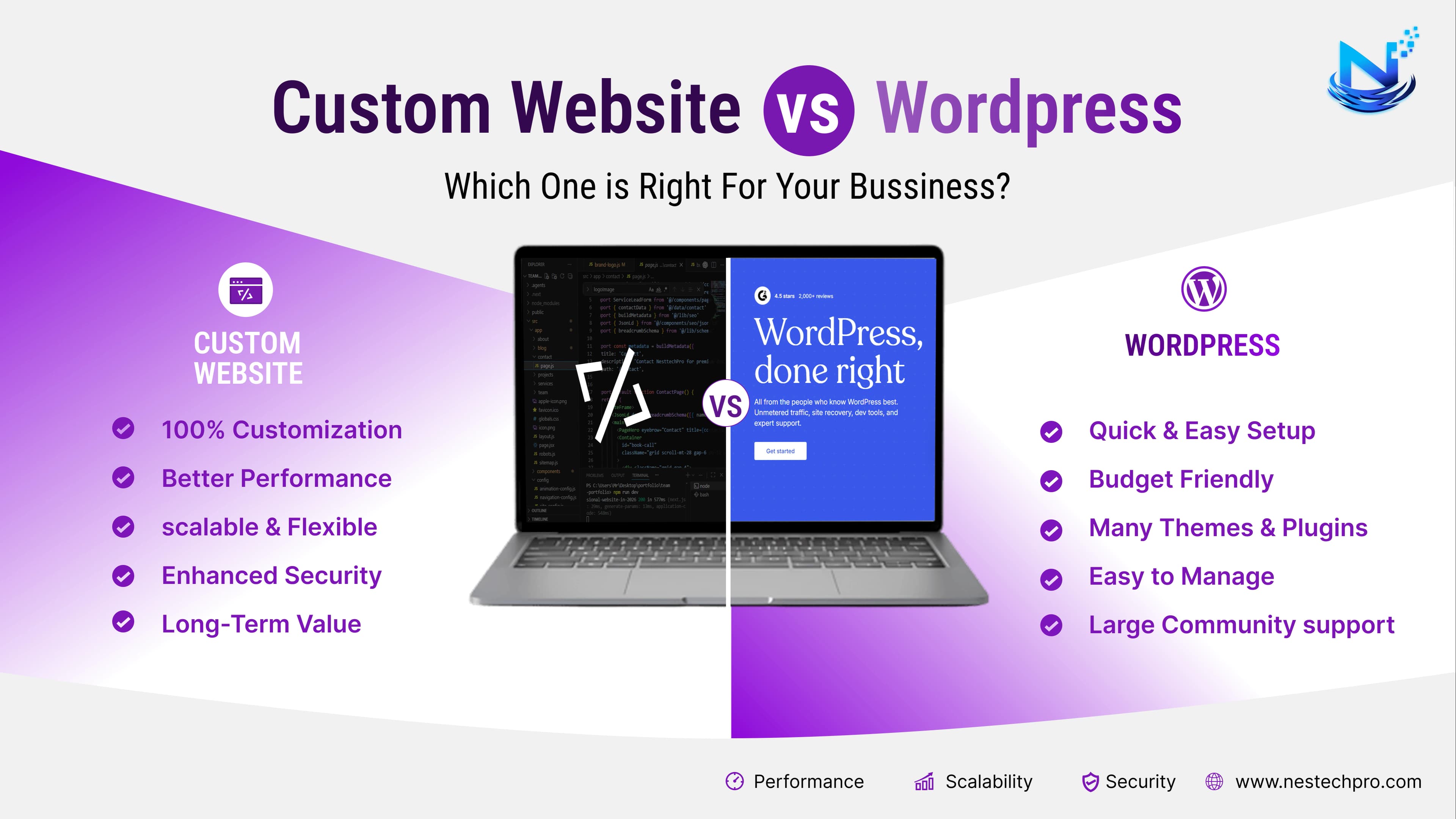
Should you choose a custom website or build your website with WordPress?
The answer isn't always straightforward because both options have unique advantages depending on your business goals, budget, scalability requirements, and long-term vision.
While WordPress powers over 40% of websites worldwide due to its flexibility and ease of use, custom websites provide unmatched performance, security, customization, and scalability for businesses that require tailored digital solutions.
In this comprehensive guide, we'll compare Custom Website vs WordPress across every important factor - including cost, SEO, performance, security, maintenance, scalability, user experience, and long-term ROI so you can confidently choose the best option for your business in 2026.
What Is a Custom Website?
A custom website is designed and developed specifically for your business from the ground up. Every feature, design element, functionality, and user experience is built according to your unique business requirements.
Unlike template-based platforms, a custom website offers complete control over every aspect of development.
Custom websites are commonly built using technologies such as:
- HTML5
- CSS3
- JavaScript
- React
- Next.js
- Angular
- Vue.js
- PHP
- Laravel
- Node.js
- Python
- ASP.NET
Since everything is developed specifically for your business, you aren't limited by themes or plugins.
What Is WordPress?
WordPress is the world's most popular Content Management System (CMS), allowing businesses to create websites without building everything from scratch.
Initially developed as a blogging platform, WordPress has evolved into a powerful CMS capable of managing:
- Business websites
- Blogs
- Portfolio websites
- Educational platforms
- Membership websites
- E-commerce stores
- Booking websites
- Corporate portals
Its large ecosystem of themes and plugins makes it attractive for businesses seeking a cost-effective and relatively quick website solution.
Custom Website vs WordPress: Quick Comparison
| Feature | Custom Website | WordPress |
|---|---|---|
| Development | Built from scratch | CMS-based |
| Customization | Unlimited | Theme & plugin dependent |
| Performance | Excellent | Good (with optimization) |
| SEO | Fully optimized | Strong with SEO plugins |
| Security | Higher control | Requires regular updates |
| Cost | Higher initial investment | Lower startup cost |
| Scalability | Excellent | Moderate to high |
| Maintenance | Developer-managed | Regular updates required |
| Speed | Very fast | Depends on hosting and plugins |
| Ownership | Full code ownership | CMS-based architecture |
1. Design Flexibility
Custom Website
A custom website provides unlimited design possibilities.
Everything from layouts to animations, forms, dashboards, and customer portals is designed specifically for your business.
Advantages include:
- Unique brand identity
- No template limitations
- Better user experience
- Advanced interactive features
- Custom functionality
Ideal for businesses wanting a distinctive online presence.
WordPress
WordPress offers thousands of pre-built themes.
While themes can be customized, many businesses using the same template end up with similar-looking websites.
Advantages include:
- Quick setup
- Affordable themes
- Visual page builders
- Easy customization
However, highly customized designs may eventually require custom coding.
2. Performance and Speed
Website speed directly impacts:
- SEO rankings
- Bounce rate
- User experience
- Conversion rate
Custom Website
Since developers only include necessary code, custom websites are generally faster.
Benefits include:
- Lightweight architecture
- Faster loading times
- Optimized code
- Better Core Web Vitals
- Improved user experience
WordPress
WordPress performance largely depends on:
- Hosting quality
- Theme optimization
- Plugin usage
- Image optimization
- Caching
A well-optimized WordPress website can perform well, but excessive plugins or poorly coded themes can significantly slow it down.
3. SEO Capabilities
Both custom websites and WordPress can rank well on Google when implemented correctly.
Custom Website SEO
Custom websites allow developers to optimize every technical SEO element, including:
- Clean code
- Custom schema markup
- Fast loading pages
- Mobile responsiveness
- Structured URLs
- Advanced metadata
- Core Web Vitals
- Server optimization
This provides maximum flexibility for long-term SEO strategies.
WordPress SEO
WordPress is known for being SEO-friendly, especially when paired with plugins such as:
- Yoast SEO
- Rank Math
- All in One SEO
These tools simplify:
- Meta tags
- XML sitemaps
- Canonical URLs
- Breadcrumbs
- Schema markup
For many businesses, WordPress offers excellent SEO capabilities without extensive technical expertise.
4. Security
Cybersecurity is increasingly important in 2026.
Custom Website
Custom websites generally provide stronger security because:
- No unnecessary plugins
- Smaller attack surface
- Custom authentication
- Tailored security measures
- Controlled codebase
Since hackers often target widely used platforms, custom-built systems may face fewer automated attacks.
WordPress
WordPress itself is secure, but vulnerabilities often arise from:
- Outdated plugins
- Poor-quality themes
- Weak passwords
- Delayed updates
Regular maintenance is essential to keep WordPress websites secure.
5. Scalability
As your business grows, your website should grow with it.
Custom Website
Custom development is ideal for businesses planning to:
- Launch customer portals
- Add complex dashboards
- Integrate APIs
- Develop SaaS products
- Build enterprise applications
- Handle high traffic volumes
Scalability is virtually unlimited.
WordPress
WordPress is scalable for many use cases, especially with high-quality hosting and optimized plugins.
However, highly complex applications may eventually outgrow the platform.
6. Cost Comparison
WordPress
Lower initial investment.
Typical costs include:
- Domain
- Hosting
- Premium theme
- Plugins
- Maintenance
Suitable for startups and small businesses with limited budgets.
Custom Website
Higher upfront cost because developers create everything specifically for your business.
However, long-term benefits include:
- Lower dependency on plugins
- Better performance
- Greater flexibility
- Easier future expansion
- Higher return on investment for growing businesses
7. Ease of Content Management
WordPress
One of WordPress's biggest advantages is its user-friendly dashboard.
Businesses can:
- Publish blogs
- Update pages
- Upload images
- Edit content
- Manage products
without needing technical expertise.
Custom Website
Content management depends on how the website is built.
Developers can integrate:
- Custom CMS
- Headless CMS
- Admin dashboards
These solutions can be tailored to your workflow but may require initial training.
8. Maintenance Requirements
WordPress
Requires regular:
- Plugin updates
- Theme updates
- Core updates
- Security monitoring
- Backups
Ignoring maintenance can lead to security risks or compatibility issues.
Custom Website
Maintenance focuses on:
- Feature enhancements
- Security monitoring
- Server maintenance
- Performance optimization
With fewer third-party dependencies, maintenance is often more predictable.
9. E-commerce Capabilities
WordPress
WooCommerce transforms WordPress into a capable online store.
Suitable for:
- Small businesses
- Medium-sized stores
- Product catalogs
- Service bookings
Custom Website
Perfect for businesses needing:
- Multi-vendor marketplaces
- Custom checkout flows
- ERP integrations
- Inventory automation
- Subscription platforms
- Enterprise commerce solutions
10. Long-Term ROI
Choosing the cheapest solution isn't always the most cost-effective.
WordPress offers:
- Faster launch
- Lower startup cost
- Easy content updates
- Strong SEO potential
Custom websites offer:
- Higher scalability
- Better performance
- Enhanced branding
- Greater flexibility
- Lower technical limitations
- Long-term competitive advantage
Which Businesses Should Choose WordPress?
WordPress is ideal for:
- Small businesses
- Personal brands
- Bloggers
- Coaches
- Local service providers
- Restaurants
- Educational websites
- Portfolio websites
- Startups with limited budgets
Which Businesses Should Choose a Custom Website?
Custom development is better for:
- Large enterprises
- SaaS companies
- Healthcare organizations
- Financial institutions
- Real estate platforms
- Travel portals
- Large e-commerce businesses
- Businesses requiring custom workflows
- Companies expecting rapid growth
Decision Checklist
Choose WordPress if you want:
- Faster launch
- Lower development cost
- Easy content management
- Standard business features
- Blogging capabilities
- A flexible CMS with a large ecosystem
Choose a Custom Website if you need:
- Unique functionality
- Enterprise-level scalability
- Superior performance
- Advanced integrations
- Maximum security control
- Complete design freedom
- A highly differentiated digital experience
SEO, E-E-A-T, AEO, and GEO Considerations
Whether you choose WordPress or a custom website, ranking well requires more than the platform itself. Focus on:
- Publishing original, experience-based content that demonstrates expertise.
- Maintaining accurate author and business information to strengthen trust.
- Optimizing page speed, mobile usability, and Core Web Vitals.
- Using descriptive headings and directly answering common user questions for answer engines.
- Adding structured data where appropriate.
- Creating dedicated pages for the cities or regions you serve and keeping your business information consistent across local listings.
These practices help improve visibility in traditional search results, AI-powered search experiences, and local searches.
Frequently Asked Questions (FAQs)
Is a custom website better than WordPress?
It depends on your business goals. Custom websites provide greater flexibility, performance, and scalability, while WordPress offers affordability, ease of use, and faster deployment.
Which option is better for SEO?
Both can achieve excellent SEO results when built and optimized correctly. Success depends on technical implementation, high-quality content, website speed, and ongoing optimization rather than the platform alone.
Is WordPress secure for business websites?
Yes, WordPress can be secure when it's properly maintained, updated regularly, uses reputable themes and plugins, and follows security best practices.
Are custom websites more expensive?
Yes. Custom websites typically require a larger upfront investment, but they often deliver stronger long-term value for businesses with unique requirements or ambitious growth plans.
Can I migrate from WordPress to a custom website later?
Yes. Many businesses start with WordPress and transition to a custom-built solution as their traffic, functionality, and operational needs grow.
Which option is best for small businesses?
For many small businesses, WordPress provides an excellent balance of affordability, flexibility, and ease of management. Businesses with highly specialized requirements may benefit more from a custom solution.
Conclusion
The choice between a custom website and WordPress ultimately depends on your business objectives, budget, technical requirements, and growth strategy.
If you need a cost-effective website with a fast launch, straightforward content management, and robust SEO potential, WordPress is an excellent choice.
If your business demands exceptional performance, advanced functionality, unique branding, enterprise-level security, or the ability to scale without platform limitations, a custom website is the smarter long-term investment.
Rather than asking which platform is universally "better," the more important question is: Which solution best supports your business goals today and where you want your business to be in the future?
By aligning your website choice with your long-term strategy, you'll create a digital foundation that not only attracts visitors but also builds trust, drives conversions, and supports sustainable business growth for years to come.